Removing the Black Hole in Plastics Recycling
Arctic® Infrared Reflective Pigments allow for a more sustainable solution to black plastic recycling
THE PROBLEM
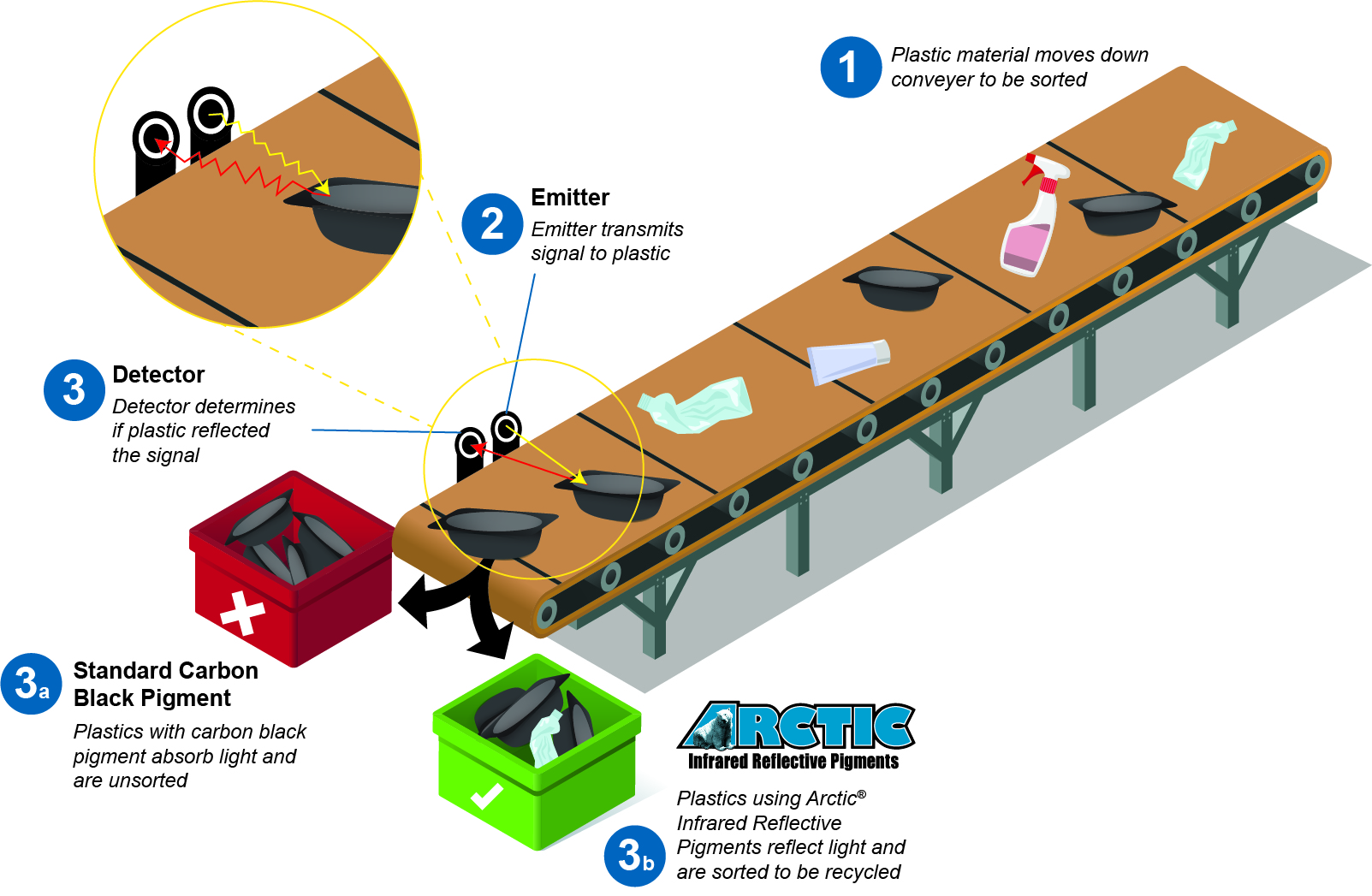
One of the major benefits of plastics and a big part of its sustainability is that they can be recycled. This benefit is optimized when the recycle stream can be sorted by polymer type as seen in Graphic 1. A common sorting method uses near-infrared (NIR) light from 700 to around 2000 nanometers (nm) to scan the plastic. The reflected NIR light can be used to identify the polymer. Carbon black is the most commonly used black pigment for many applications, including the coloration of plastics. It is economical, has high coloring and visual opacity properties and acts as a UV absorber. The problem is that the carbon black pigment interferes with the reflectance by absorbing the NIR light which makes identifying the polymer impossible. This impedes the recycling of up to 10% of plastics at some facilities1. If the material can’t be recycled it will often end up in a landfill. Since black is a very popular color for packaging, especially food tray packaging, a black pigment is needed that doesn’t interfere with the NIR scanning and has regulatory acceptance for food packaging.
NIR Sorting of PlasticsGraphic 1
Download the rest of the article here to read how this technology can help reduce waste in landfills.
Share This Story, Choose Your Platform!
Recent posts
September 25, 2026
2026: One Hot Summer, The Urban Heat Island Effect
September 24, 2026
Shepherd Color Featured in September 2026 Edition of Compounding World
July 14, 2026
Expanding the Durable Color Envelope with NTP Yellow and RTZ Orange
June 4, 2026
Innovative IR Black Pigments
March 16, 2026
Shepherd Color: 60 Years of Exposure
December 18, 2025
Happy Holidays from The Shepherd Color Company