2026: One Hot Summer, The Urban Heat Island Effect
What is an Urban Heat Island?
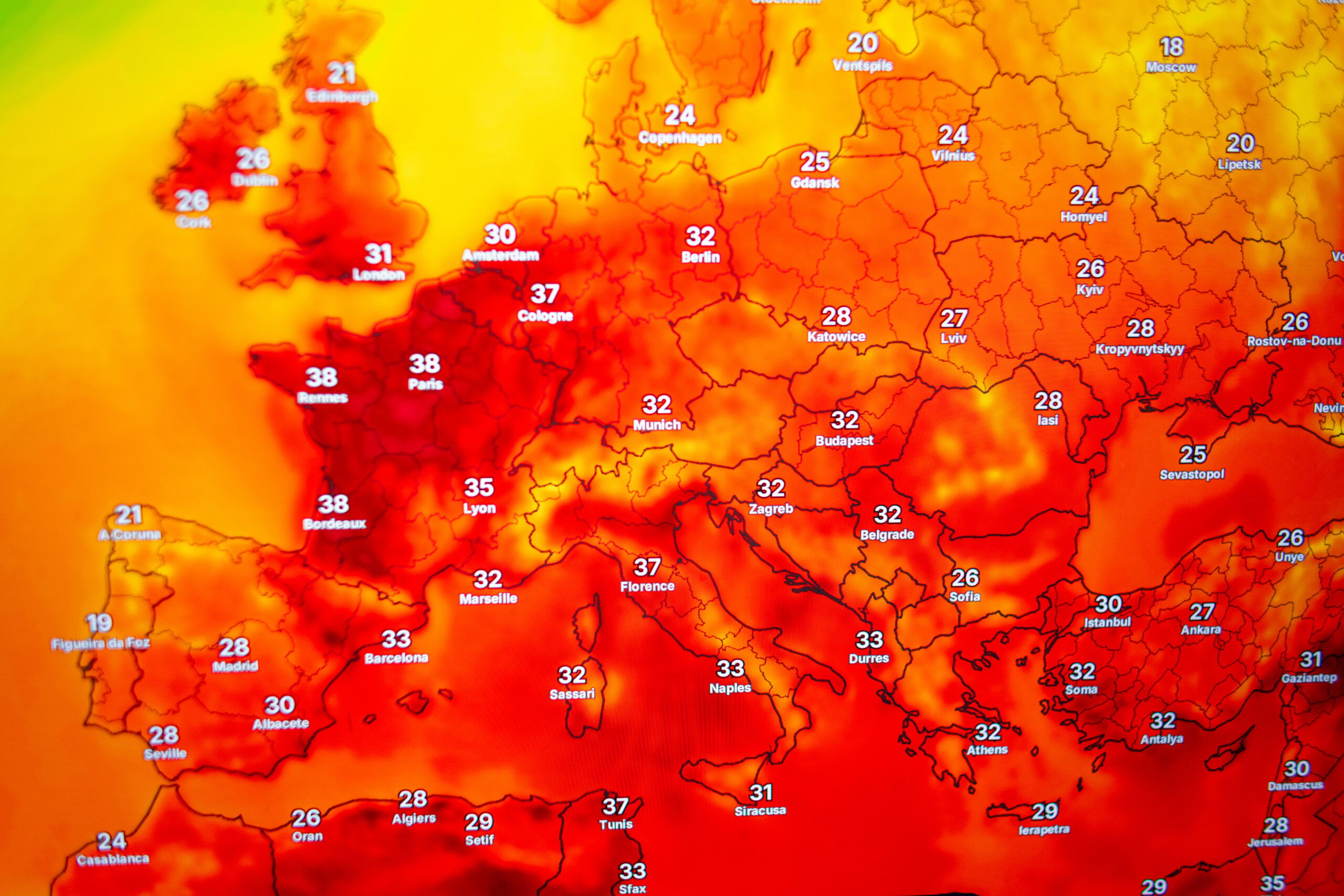
Cities continue to struggle with the heat that gets trapped in urban landscapes that drives temperatures higher, air quality down, and livability sideways. In the summer of 2026, European city temperatures consistently crossed 104°F (40°C), with record high day and nighttime temperatures in Slovakia. June and July temperatures in Western Europe were the highest on record, according to Europe’s Copernicus climate monitoring service1. Only 23% of homes in Europe have air conditioning compared to 90% in the U.S. As AC use increases, so will energy consumption and peak energy demand on hot days.
What could help with Urban Heat Islands?
The Shepherd Color Company’s Arctic® infrared (IR) reflective pigments have been used for decades in cool roofing applications to directly address energy demands and mitigate the impact on the electrical grid. This technology is finding use in other areas of cityscapes. Walls and horizontal surfaces like parking structures and roads are being reviewed as ways to reduce the energy absorbed and the heat present in urban areas. These spaces absorb and trap heat during summer days and create urban heat islands (UHIs). The higher temperatures contribute to reduced air quality, increased energy needed to cool buildings, and overall reduced quality of life and sustainability.
Only half of the sun’s spectrum is visible to the human eye. A few percent is in the damaging ultraviolet (UV) wavelengths, but roughly half of the sun’s energy is in the invisible IR range. Shepherd Color’s Arctic infrared reflective pigments excel in selectively absorbing visible wavelengths for color, while reflecting and rejecting the invisible IR wavelengths. This allows darker colors to behave thermally like middle gray colors. While white will always be the most reflective and coolest color, the stark white color can cause issues with ergonomics and aesthetics.
The Pavement Experiment Using Arctic Infrared Reflective Pigments
To explore the potential of using IR black pigments to make cool gray colors, we started an experiment on the parking surfaces of our global-scale plant for producing our pigments just north of Cincinnati, Ohio (USA). We painted a roughly square meter with a medium gray color made with our Black 30C940 and standard white pigment. This one-of-a-kind pigment takes our Arctic IR technology and adds in our Dynamix® easily dispersed pigment technology.
We then waited for a warm, sunny, cloudless summer day where the temperature exceeded 90F° (32°C) with 50% humidity and calm winds. As can be seen in the visible spectrum Photo 1 and false color FLIR image in Photo 2, the IR gray surface is cooler than the uncoated surface, even though both are exposed to the same solar heating.
This small-scale experiment shows the potential for the technology. Cool Pavement Research done by the Heat Island Group at Berkeley Lab2 examines the potential for energy savings, improved air quality, and even improved driver safety and reduced need for street lighting due to lighter surfaces.
-
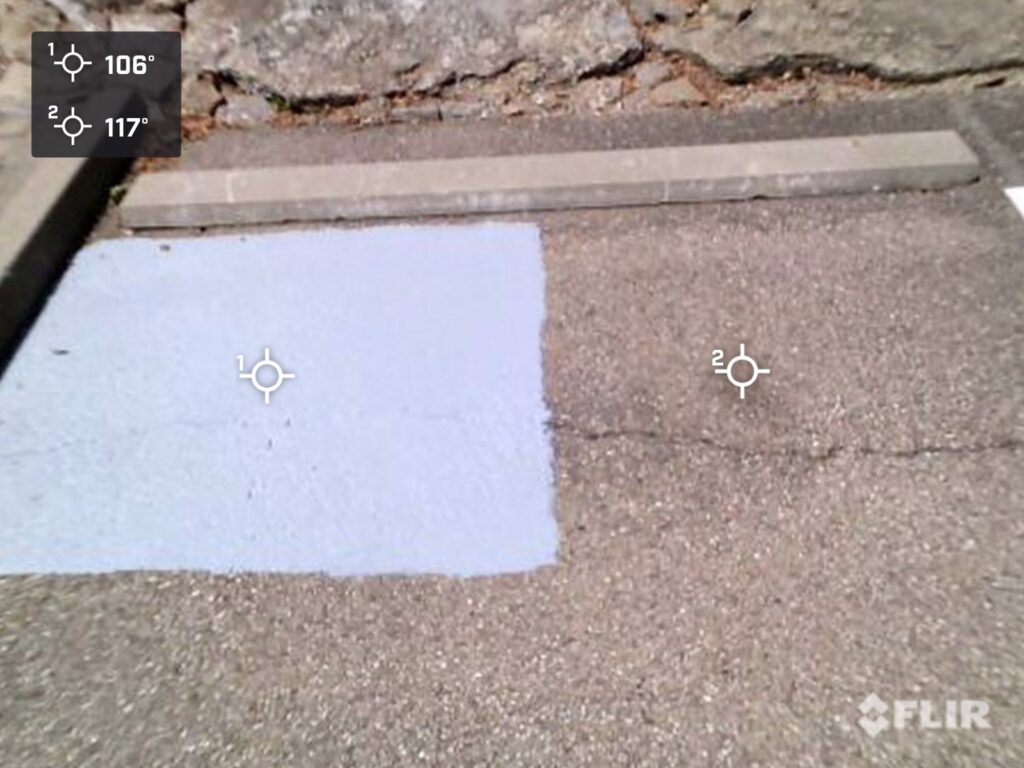
- Photo 1: A visible wavelength picture of the surface temperatures from a FLIR camera showing the IR coating on the left having a temperature of 106°F (41°C) and the uncoated area a surface temperature of 117°F (47°C).
-

- Photo 2: An image using the FLIR camera to use color to display temperature with yellow denoting higher surface temperatures, and violet showing cooler areas.
Shepherd Color’s Arctic Infrared Reflective Pigments
Shepherd Color’s Arctic pigments provide highly-durable, IR reflective colors for numerous applications in a wide range of colors. Black cool roofs made with stone-coated asphalt shingles or pre-painted metal use our Arctic Black 10G996, Black 30C940 and Black 30C941. As seen in the pavement study, they can also be used in gray colors. Beyond black and gray pigments, Arctic Green 10C650 boosts reflectivity across a wide spectrum of colors, extending cool roof benefits. Whether you’re targeting traditional dark tones or colors like weathered copper, we can help develop cooler, energy-efficient formulations.
Shepherd Color’s Arctic pigments give you tools to help fight urban heat island and the worst of high summer temperatures, watch the video:
This article is a follow up to our Urban Heat Island Article from 2024. You may also learn more about IR technology from our Cool Roof presentation in Milan from 2025.
—
ABOUT THE SHEPHERD COLOR COMPANY
Founded in 1981, The Shepherd Color Company produces a wide range of high-performance Complex Inorganic Color Pigments (CICPs) used in a variety of industries. These pigments are an extraordinary class of inorganic pigments that offer stable, long-lasting color for many applications. They have unbeatable weatherability, heat and chemical resistance, are non-warping and easy to disperse. Shepherd Color, we brighten lives. Follow us on LinkedIn!
Share This Story, Choose Your Platform!
Recent posts
October 8, 2026
Shepherd Color Named a PPG 2025 Excellent Supplier Award Winner
September 25, 2026
2026: One Hot Summer, The Urban Heat Island Effect
September 24, 2026
Shepherd Color Featured in September 2026 Edition of Compounding World
July 14, 2026
Expanding the Durable Color Envelope with NTP Yellow and RTZ Orange
June 4, 2026
Innovative IR Black Pigments
March 16, 2026
Shepherd Color: 60 Years of Exposure