Black plastic: listed or blacklisted?
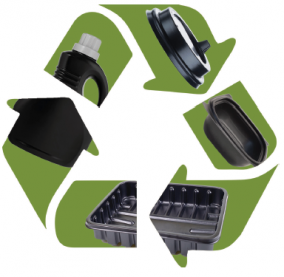
(Excerpt from Plastics in Packaging November 2019 Issue) The colour black in food and other types of consumer packaging has become a hotly-contested topic, given the challenges with carbon black in identifying the base polymer for recycling. Paul Gander looks at some of the alternative strategies.
While the majority of plastics packaging might be said to have a ‘visibility’ problem, which counts against it in the eyes of many consumers and much of the media, with black plastics this is more of an ‘invisibility’ problem.
Whether the packaging is black or a dark containing the same colourant, the challenge is that carbon black can render the item undetectable by near-infrared (NIR) identification systems, typically used in materials recovery facilities (MRFs) around the world. As a result, this stream has frequently been inaccurately described as ‘unrecyclable’.
In the UK especially, this is one plastics-related issue that predates the BBC Blue Planet 2 marine wildlife series, as business development manager at Faerch Plast UK Ruth Price explains. “Even before then, there was a lot of media attention given to the way black plastics were not being recycled,” she says. “That in turn was putting pressure on the use of black trays, even though they are recyclable.”
Are black plastics just a UK problem? At The Shepherd Color Company in the US, marketing manager Mark Ryan says it is now on its fifth generation of IR blacks, developed over some 40 years. But applications to date have principally been in vinyl for outdoor use requiring solar reflectivity. Those same properties make the additives ideal for IR reflectivity.
Following Europe’s lead, the issue of black plastics packaging and recycling is starting to come to the fore in the US, says Ryan. He highlights the boom in food delivery services in the US where, he says, providers will often use black plastics for their meals.
More broadly, he says: “Recycling rates in the US are so much lower, generally, than in Europe. Any initiative that helps has to be good.”
Read the entire article here and learn more about Shepherd Color’s Arctic Black 10P925, a product optimized for IR sorting in plastics.
Share This Story, Choose Your Platform!
Recent posts
October 8, 2026
Shepherd Color Named a PPG 2025 Excellent Supplier Award Winner
September 25, 2026
2026: One Hot Summer, The Urban Heat Island Effect
September 24, 2026
Shepherd Color Featured in September 2026 Edition of Compounding World
July 14, 2026
Expanding the Durable Color Envelope with NTP Yellow and RTZ Orange
June 4, 2026
Innovative IR Black Pigments
March 16, 2026
Shepherd Color: 60 Years of Exposure