Zeta Potential, Isoelectric Point, and Dispersion Stability
Introduction
Technical publications about pigments and dispersions often make references to the terms “Zeta Potential” and “Isoelectric Point”. Some formulators may not be familiar with these concepts. This paper is intended to help explain what these terms mean and how they affect pigment dispersion stability in the simplest terms possible. It also will discuss the Shepherd Color Company’s Dynamix® “Stir-In” grade pigments and how Zeta Potential and Isoelectric Point are different with this technology versus conventional pigments.
Background
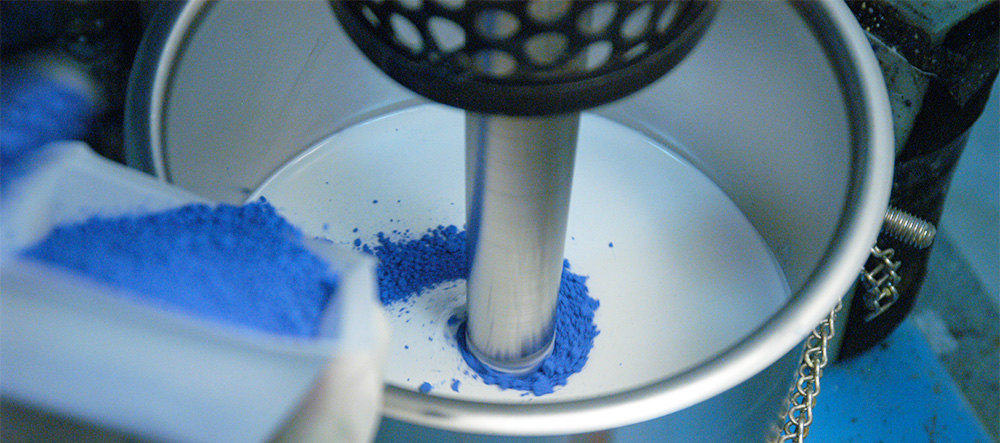
The three basic states of matter are solids, liquids and gases. If one of these, a solid, is very finely divided within a liquid it may be called a “dispersion”. In the case of waterborne coatings or color concentrates, the solid material is pigment (and also possibly polymer particles) suspended in a liquid which is water. The pigment particles may be inorganic, organic, or combinations of both. The preparation of coatings or color concentrates involves dry powder pigments being introduced into liquid water under mechanical shear in order to wet them out completely. With standard pigments this is generally not possible without the addition of a chemical dispersant to aid in the wetting and de-aerating of the powder. Milling through a high energy media mill is then routinely needed to achieve the optimum particle size. Ideally, the chemical dispersant selected will also provide inter-particle repulsion of the pigments so that the dispersed particles do not re-agglomerate to any extent. Often this is not the case and combinations of dispersant(s) with other surface active ingredients are needed to obtain a stable formulation.
Share This Story, Choose Your Platform!
Recent posts
July 14, 2026
Expanding the Durable Color Envelope with NTP Yellow and RTZ Orange
June 4, 2026
Innovative IR Black Pigments
March 16, 2026
Shepherd Color: 60 Years of Exposure
December 18, 2025
Happy Holidays from The Shepherd Color Company
October 31, 2025
IR pigment technology is the key to successful cool building products
October 28, 2025
It’s Halloween – Celebrating Arctic IR Blacks and RTZ Orange and Violets